
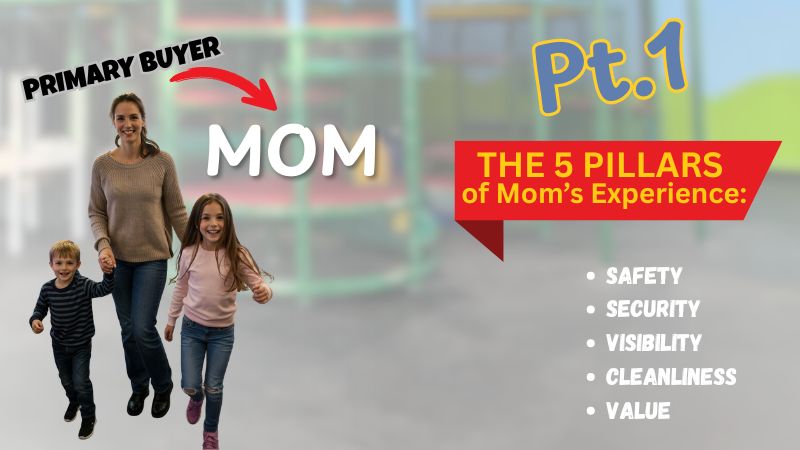
The Primary Buyer—Why You Can’t Afford to Ignore Mom
In the indoor play industry, there is a common misconception that if you build something “flashy” enough, children will force their parents to bring them back. While the kids are certainly your end users, the person holding the keys, the credit card, and the calendar is Mom. She is the researcher, the budget-manager, and the primary judge of your facility’s worth.
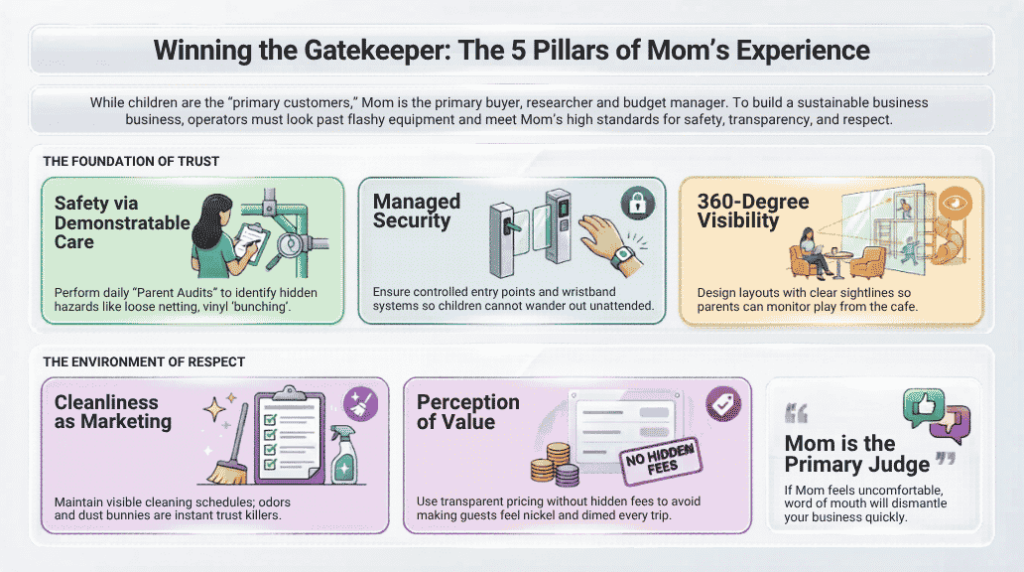
At Northwest Play, we’ve talked with our customers, and analyzed hundreds of customer interactions to determine exactly what Mom is looking for. She isn’t just looking for a playground; she’s looking for an environment where she feels safe, respected, and valued. If she feels uncomfortable or undervalued—no matter how great your slides are—word of mouth will dismantle your business faster than any marketing campaign.
1. Safety: The Baseline of Trust
Safety is the first and most persistent question in a parent’s mind. They are assessing the structural integrity of your equipment from the moment they walk in. Today, parental standards for safety have shifted from meeting code to demonstrable care.
What to Check:
Don’t just look for certifications. Inspect the hidden zones—under the stairs, behind the slides, and in the corners. If a parent sees rust, missing padding, or loose bolts, their trust is gone.
Perform a Parent Audit daily: walk through as if you were dropping off your own child for two hours. If you see something that makes you hesitate, Mom will see it too.
2. Security: Peace of Mind in a Managed Space
Security is the sibling of safety, but it’s more about management. Mom wants to know that your facility is a controlled environment. She needs to know who belongs in the space and that her child cannot simply wander out.
What to Check:
Evaluate your entry and exit points. Are they staffed at all times?
Do you use a wristband or badge system to ensure children are matched with the correct adult?
Security also covers personal space—does she have a place to sit where she can watch her bag and her child simultaneously? If she feels uneasy, she won’t stay long.
3. Visibility: Transparency Through Design
Visibility is about the parent’s perceived control. Can they see what is happening without having to climb into the structure themselves? A facility that looks open and bright signals transparency and trustworthiness.
What to Check:
Identify your blind spots. If a parent is stuck behind a wall or a maze of corridors, they feel disconnected from the play experience.
Strategic layouts should allow for 360-degree sightlines from the café or lounge area. If Mom can’t see her child, she’ll be watching the clock rather than relaxing.
4. Cleanliness: The Silent Marketing Engine

To a parent, cleanliness equals respect. Dust, sticky floors, and unkept restrooms tell Mom that she isn’t your priority. In a post-pandemic landscape, high-touch surfaces must be cleaned on a visible, documented schedule.
What to Check:
Look at your “dust bunny” traps—under slides and on top of platforms. Smells are also a major factor; if your facility smells like old socks or stale trash, Mom’s internal alarm goes off. A clean facility isn’t just a chore; it’s your most effective marketing tool.
5. Value: More Than Just the Price Tag
Value is the perceived benefit for the time, money, and effort spent. Mom is comparing your facility to the free alternative (staying home) or other local entertainment.
What to Check:
Are your prices transparent? Hidden fees or upcharges for basic access are the fastest way to make a guest feel nickel and dimed.
Value is also found in stay-time; if your facility is overcrowded or understaffed, the value drops. When she says, ‘It wasn’t worth it,’ she tells her entire network.
Bottom Line:
By mastering these five pillars, you aren’t just running a business; you’re building a destination that earns a mother’s trust—and her repeat business.