
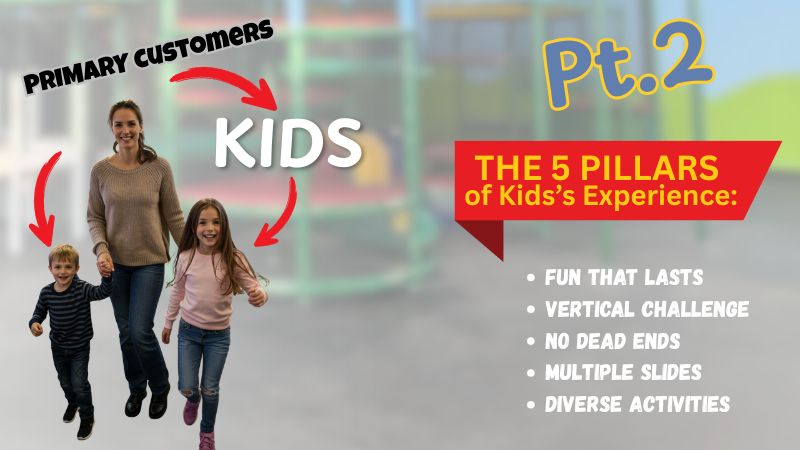
The Primary Customer—Designing for the Kid’s Experience
While Mom makes the decision to visit, the children determine how long they stay and how loudly they beg to come back. In the modern Family Entertainment Center (FEC) landscape, “soft play” isn’t enough. Children today are accustomed to high-engagement digital and physical stimulation.
To keep them engaged, your equipment must hit the 5 Pillars of Kids’ Experience.
1. Fun That Lasts: Increasing Stay-Time
The “stay-time” of a guest is directly linked to your revenue—longer stays lead to more food and beverage sales. Fun that lasts means creating a narrative-driven environment where play isn’t just a physical act, but an immersive experience.
The Strategy:
- Incorporate themed ‘Hot Spots’ and gamified elements. Whether it’s a jungle adventure or a futuristic space station, the environment should spark the imagination and have enough tactile experience to pull the child back again.
- When a child feels like they are part of a story, they are less likely to get bored after twenty minutes.
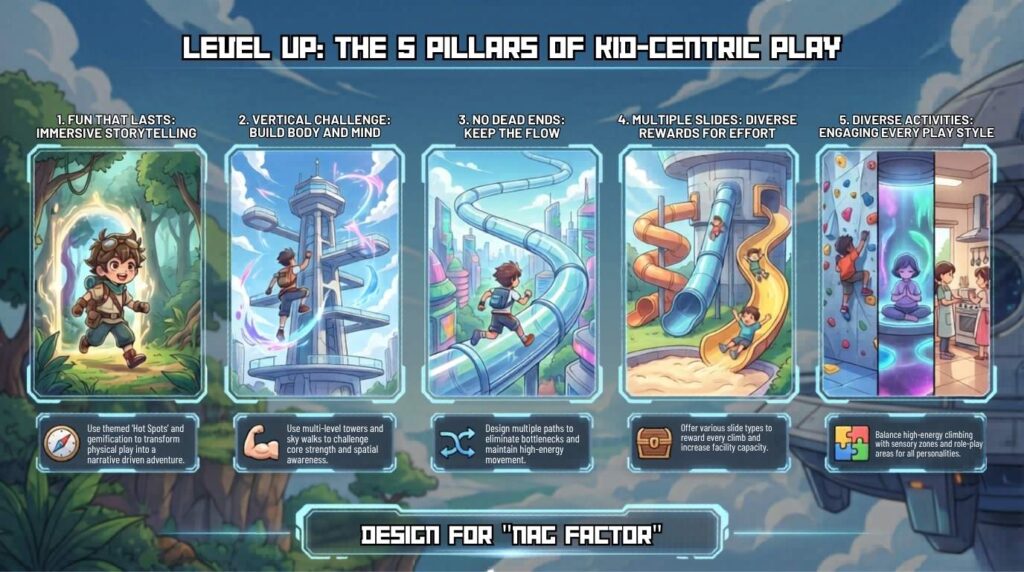
2. Vertical Challenge: Strengthening Bodies and Minds
For target aged guests (4-10 years), vertical play is a major trend driven by the need for core strength and motor skill development. Climbing upward challenges a child’s spatial awareness and bilateral coordination. It also challenges their courage as they progress from 4 to 9 years.
The Strategy:
- Move beyond horizontal tunnels. High-climbing nets, multi-level towers, and sky-bridges allow children to use their upper body and core in ways that standard playgrounds don’t.
- This verticality also maximizes your floor space, giving you more play value per square foot of real estate.
3. No Dead Ends: Ensuring Continuous Flow
Nothing kills the energy of a playground faster than a dead end—a spot where a child reaches the end of a path and has to turn around. This creates bottlenecks and social friction.
The Strategy:
- Design for looping play. Every path should lead to a choice: a slide, a climb, or a transition to another zone.
- A continuous flow keeps the energy high and allows children of different ages to share the space without colliding or getting stuck in corners.
4. Multiple Slides: The Reward for the Climb
Kids love to climb and slide, and slides are the payoff for the physical effort of climbing. However, having just one slide leads to long lines and frustration.
The Strategy:
- Incorporate a variety of slide types—tube slides for thrill, wave slides for racing, and smaller toddler slides for the little ones.
- Having multiple exit points from the upper levels ensures that the climb always feels worth it. It also increases the overall capacity of your structure.
5. Diverse Activities: Catering to Every Personality
Not every child plays the same way. Some are high-energy climbers, while others prefer sensory play or role-playing.
The Strategy:
- A successful facility balances physical challenges with quiet zones or sensory-rich areas.
- Today we are seeing a strategic rise in Hybrid Play Zones that integrate STEM activities, digital interaction, and role-play towns alongside the traditional slides.
- This diversity ensures that whether a child is 3 or 10, they find a reason to stay engaged.
Conclusion:
When you design for the kid’s experience, you are designing for pester power. If a child has the best two hours of their week at your facility, they become your most loyal brand ambassador.